
 arXiv
arXivWe present a method for generating plausible counterfactual explanations (CFEs) for time series classification via gradient-based optimization in input space. Plausibility is enforced by aligning the generated CFE with \(k\)-nearest neighbors from the target class using soft-DTW — a differentiable relaxation of dynamic time warping. The optimization objective balances validity, proximity, sparsity, and the novel soft-DTW plausibility term. Across eight datasets, our method achieves perfect or near-perfect validity while outperforming baselines in distributional alignment with the target class by up to an order of magnitude in DTW distance.
Method
We seek a counterfactual \(X'\) for a time series \(X\) with predicted class \(\hat{y} = f(X)\), targeting \(y_{\text{target}} \neq \hat{y}\). The optimization objective is:
\[ \mathcal{L}_{\text{CF}} = \mathcal{L}_{\text{prox}} + \mathcal{L}_{\text{sparse}} + \lambda \cdot (\mathcal{L}_{\text{valid}} + \mathcal{L}_{\text{DTW}}), \]
\[ \mathcal{L}_{\text{prox}} = \tfrac{1}{dT}\|X' - X\|_2^2, \qquad \mathcal{L}_{\text{sparse}} = \tfrac{1}{dT}\|X' - X\|_1, \]
\[ \mathcal{L}_{\text{valid}} = \max\!\left(0,\, \tau - p_f(y_{\text{target}} \mid X')\right), \qquad \mathcal{L}_{\text{DTW}} = \frac{1}{k}\sum_{Y \in \mathcal{N}_k(X,\, y_{\text{target}})} \text{DTW}^\gamma(X', Y). \]
Soft-DTW (Cuturi and Blondel 2017) replaces the hard minimum in standard DTW with a smooth approximation parameterized by \(\gamma > 0\), making the alignment cost differentiable with respect to \(X'\). The plausibility term \(\mathcal{L}_{\text{DTW}}\) pulls \(X'\) toward the \(k\) nearest target-class training examples, encouraging realistic temporal structure rather than adversarial perturbations. We optimize \(X'\) by gradient descent with classifier weights frozen. Defaults: \(\lambda = 1\), \(k = 10\), \(\gamma = 1\).
Qualitative Results
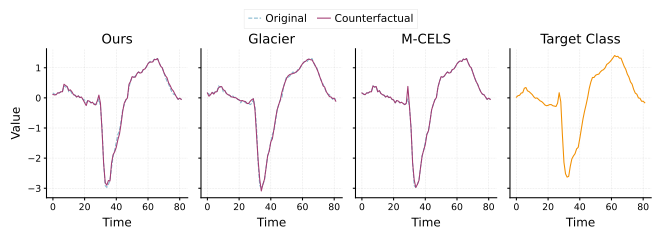
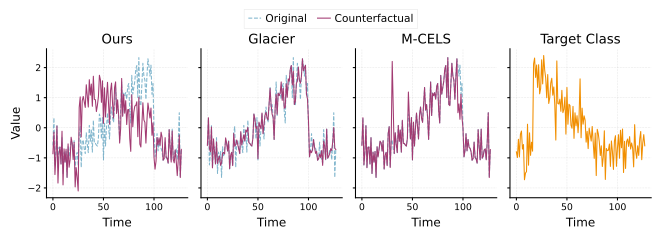
The figures below compare counterfactuals produced by our method, Glacier (Wang et al. 2024), and M-CELS (Li et al. 2024).
On TwoLeadECG, both our method and M-CELS capture the prominent target-class peak; Glacier produces subtle changes that miss it entirely.
The contrast is sharper on CBF — three geometrically distinct classes (Cylinder, Bell, Funnel). Our method produces a CFE that clearly adopts the target shape. Glacier and M-CELS generate perturbations that resemble adversarial noise rather than meaningful class transformations.
Quantitative Results
Evaluated on eight UCR/UEA datasets (Dau et al. 2019) against Glacier (Wang et al. 2024) (univariate only) and M-CELS (Li et al. 2024). Metrics: Validity (\(\text{Val}\uparrow\)), \(L_1\)/\(L_2\) distance (\(\downarrow\)), average DTW to 10 nearest target-class neighbors (\(\downarrow\)), Isolation Forest Score (\(\uparrow\)).
| Dataset | Method | \(\text{Val}\uparrow\) | \(L_1\downarrow\) | \(L_2\downarrow\) | \(\text{DTW}\downarrow\) | Iso Forest\(\uparrow\) |
|---|---|---|---|---|---|---|
| CBF | Ours | 1.000 | 9.871 | 1.071 | 0.194 | 1.000 |
| Glacier | 0.360 | 4.062 | 0.540 | 1.415 | 0.987 | |
| M-CELS | 0.226 | 1.500 | 0.486 | 2.402 | 0.984 | |
| TwoLeadECG | Ours | 1.000 | 1.446 | 0.214 | 0.016 | 1.000 |
| Glacier | 0.233 | 0.484 | 0.115 | 0.064 | 1.000 | |
| M-CELS | 0.970 | 0.245 | 0.119 | 0.302 | 0.879 | |
| GunPoint | Ours | 0.975 | 4.478 | 0.491 | 0.155 | 1.000 |
| Glacier | 0.000 | 0.639 | 0.170 | 0.436 | 1.000 | |
| M-CELS | 0.425 | 0.129 | 0.074 | 2.317 | 0.925 | |
| Earthquakes | Ours | 1.000 | 48.985 | 2.441 | 0.775 | 0.924 |
| Glacier | 0.000 | 8.528 | 0.661 | 1.907 | 1.000 | |
| M-CELS | 0.174 | 6.765 | 1.167 | 0.288 | 1.000 | |
| Coffee | Ours | 1.000 | 5.979 | 0.489 | 0.064 | 1.000 |
| Glacier | 0.455 | 9.182 | 0.795 | 1.024 | 1.000 | |
| M-CELS | 1.000 | 0.527 | 0.183 | 0.423 | 0.636 | |
| ItalyPowerDemand | Ours | 1.000 | 0.869 | 0.222 | 0.015 | 1.000 |
| Glacier | 0.023 | 0.307 | 0.107 | 0.054 | 1.000 | |
| M-CELS | 0.466 | 0.178 | 0.091 | 0.369 | 0.831 | |
| Cricket | Ours | 1.000 | 475.900 | 12.210 | 0.810 | 0.972 |
| Glacier | N/A | N/A | N/A | N/A | N/A | |
| M-CELS | 0.194 | 54.403 | 2.636 | 65.924 | 0.888 | |
| Epilepsy | Ours | 1.000 | 68.130 | 3.138 | 3.445 | 1.000 |
| Glacier | N/A | N/A | N/A | N/A | N/A | |
| M-CELS | 0.272 | 14.807 | 1.623 | 19.213 | 1.000 |
Our method achieves perfect or near-perfect validity on all datasets and the best DTW plausibility score everywhere — often by an order of magnitude (e.g. 0.016 vs. 0.302 on TwoLeadECG; 0.810 vs. 65.924 on Cricket). The higher \(L_1\)/\(L_2\) values reflect an inherent trade-off: enforcing temporal realism requires larger, more structured modifications than simply minimizing perturbation magnitude.
Conclusions
Explicit soft-DTW alignment with target-class neighbors is a simple and effective mechanism for producing plausible time series counterfactuals. It delivers near-perfect validity and substantially better distributional alignment than existing methods, at the cost of larger perturbations — confirming that meaningful temporal realism requires more structured changes than proximity-minimizing methods admit.
Supported by the National Science Centre (Poland), Grant No. 2024/55/B/ST6/02100.